

How Leverage Works In Forex
Ane of the main features of CFD and forex trading is the power to utilise leverage. But before yous get started, it's worth learning exactly how leverage and margin work.
What is leverage?
Leverage is a tool used by traders that enables you to control a large corporeality of capital by putting down a much smaller amount. Different traditional investing, where you must pay for the total value of your position upfront, with leveraged trading you simply have to pay a deposit known as your margin.
In the case of 50:1 leverage, for instance, you can use £i to control a position worth £l.
Leverage has opened markets such equally forex and commodities to more retail traders, who don't desire to allocate big amounts of upper-case letter to each position. However, information technology volition magnify the profits and losses from any merchandise, so should exist used with caution.
What is margin?
Margin is the upper-case letter that y'all'll have to put down to open a leveraged trade. Different markets will have different margin requirements. You might take to pay twenty% of the full value of a shares position, for instance – while yous could only take to put downwardly five% with FX.
CFD trading is a pop way of accessing leverage when buying and selling shares, indices, forex and more than. Let's examine how it works in practise.
Leverage case: share trading vs CFDs
Share investingYous buy i,000 shares in company XYZ, with a share price of 250p. The value of your merchandise is £2500. Y'all're buying shares outright, and so you accept to pay the full amount upfront. Profit If company XYZ'south share price rises to 260p, then you tin can sell your shares for £2600 – earning y'all a £100 profit. You've made £100 from £2500, a render of 4%. Loss But what if XYZ's share toll brutal to 240p? You lot'd lose £100, or a 4% loss. | Share CFDsYou buy 1,000 share CFDs in company XYZ, with a share price of 250p. CFDs in company XYZ have a margin requirement of 20%, so you only accept to pay £500 to open up. Profit If visitor XYZ's share price rises to 260p, then you can sell your CFDs to realise a £100 gain. You've made £100 from £500, a profit of 20%. Loss You'd still lose £100 on the CFD merchandise – only because you only put downwardly £500, that equates to a twenty% loss. |
As you can see in the higher up case, margin volition multiply both your profits and your losses. Because of this, using orders equally part of a comprehensive take a chance management plan is crucial when using leverage. We'll cover this in more particular in the Strategies and risk course.
Margin calls
You'll always need to ensure that you have enough margin in your business relationship to embrace the price of your open trades. If yous don't, then yous could quickly notice yourself on a margin call, which means your positions volition exist at risk of existence closed out.
If you drop below fifty% of your margin requirement, your position volition be closed automatically.
Returning to our example, say that company XYZ's share price drops to 220p. Your running loss from the trade would be £300, which would mean that you have less than half of the £500 required to maintain your position. At this point, yous'd exist at risk of seeing it get automatically airtight.
This is to foreclose your losses from condign too big.
If you go placed onto a margin telephone call, nosotros'll let you lot know via email. At this bespeak, y'all have three options:
- Close out your position
- Reduce the size of your trade to gratuitous up some equity in your business relationship
- Add boosted funds to your account to comprehend the shortfall in margin plus boosted funds to sustain whatsoever further losses
If yous leave your position and it drops to 50% of margin, we'll close it automatically.
Leverage costs
Equally with standard investing, you lot'll take to pay to open a leveraged trade – via either commission or the spread. When you pay via the spread, the costs of your trade are incorporated into the bid and enquire prices. With commission, they are separate.
You lot'll also pay borrowing costs on positions that you keep open for more than a single day. This is called overnight financing.
Overnight financing is essentially an involvement payment to embrace the toll of your leverage. At FOREX.com, we charge 2.5% above or beneath SONIA (or an equivalent interest rate), depending on whether you have a long or brusk position open up.
On positions with no expiry, overnight financing will be charged each day that your trade is open. With forwards, the cost of financing is already incorporated into the spread, and so you don't have to pay each 24-hour interval.
Calculating overnight financing
To summate overnight financing on a long position, you take its size at the finish of the 24-hour interval and multiply information technology by SONIA plus two.5%. Then you separate that figure by 365 to get a daily rate.
Did you know? Yous don't take to summate the financing charge manually whenever you trade. On the FOREX.com platform, y'all tin can meet the overnight financing charge for any market past looking at the Marketplace 360 tab.

Say you lot ain one thousand CFDs at 450p at the finish of the trading day and SONIA is 3%.
- Your position is worth £4500
- SONIA + two.5% = 5.5%
- 5.5% of £4500 = £247.l
- £247.fifty / 365 = 68p
When shorting, meanwhile, the calculation is the same – except that you lot minus 2.5% off SONIA instead of adding it. Your business relationship may be credited with the overnight financing fee, depending on interest rates.
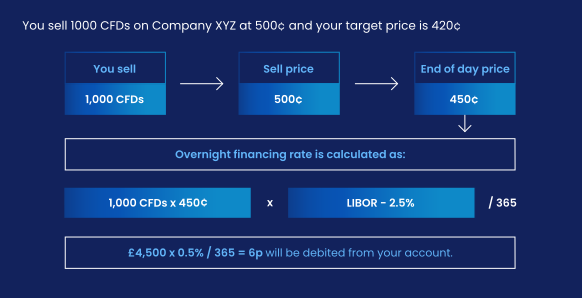
- Your position is worth £4500
- SONIA - 2.five% = 0.five%
- 0.five% of £4500 = £22.50
- £22.50 / 365 = 6p

Source: https://www.forex.com/en-uk/trading-academy/courses/to-trade/uk-introduction-to-leverage/
Posted by: maddenentioncesay.blogspot.com
0 Response to "How Leverage Works In Forex"
Post a Comment